
No B.S., No Narrative Rewrite
Why Venture Firm DSG Publishes Its Investment Thinking in Public
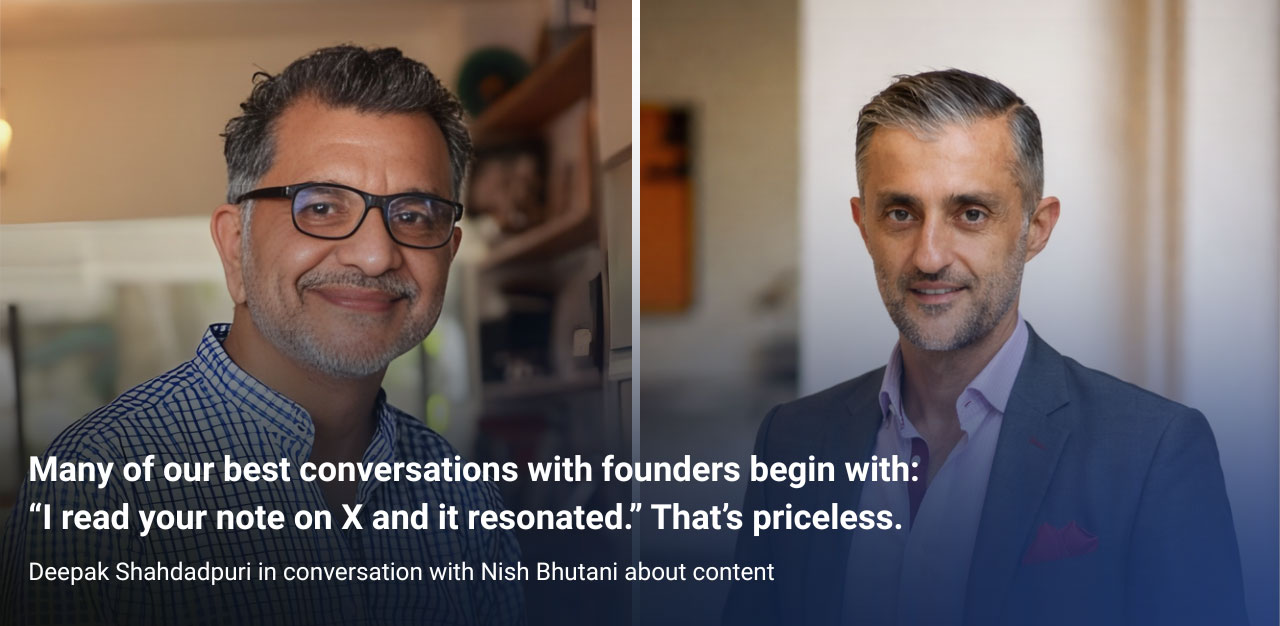
Nish Bhutani, Founder, Indiginus sat down for a candid conversation with Deepak Shahdadpuri, MD & Founder at the highly successful India and SEA focused venture firm – DSG Consumer Partners (DSGCP), on content, transparency, and the surprising power of publishing when it comes to investing.
Nish: You have said in the past that you like to “Invest in public” – meaning that your decisions and thought process are available for everyone to see – and that is a driver for publishing content. That is a bold choice for a venture firm.
What inspired you to take that route, especially when many VC firms not only operate behind closed doors but regard their ‘closed door policy’ as adding to their firm’s appeal by coming across as secretive or exclusive?
Deepak: “No B.S., No Narrative Rewrites” is actually a pretty accurate description of what we’re trying to do at DSG.
I literally put my home on the line twice when I got into the VC business. The first time was in 2004, when I left Reuters Venture Capital, started as an independent VC, and founded Gem India Advisors. The second time was when I started DSG Consumer Partners in 2012, and again had to bootstrap the first fund, which was $12.5 million, and I was the largest investor in that fund.
That experience hard-wired a certain respect for the people whose capital we manage and the founders we partner with. I am not a traditional VC investing someone else’s capital and sits behind a velvet rope. I see myself as an entrepreneur and partner first.
I was crystal clear I wanted to build a specialist firm: we back insurgent consumer brands in India and Southeast Asia. Remember that at that time we were the first and only consumer brands-focused VC in both markets. Since then, we have now partnered with 100+ founders building 90+ brands across the region.
Given how focused we were, the team realised our thinking should be visible. I give credit to the team for this. If we say we understand consumer behaviour, capital efficiency, and brand building “brick by brick”, then we should be willing to show our homework.
“Investing in public” is simply that: making our thesis, our frameworks, and our decisions public domain. It started with internal memos and evolved into public notes: the Why We Partnered With… series for new investments and Why We Doubled Down… notes when we follow on.
I think the world has shifted. Founders are more sophisticated. LPs are more informed. Young talent is allergic to opacity. Publishing our thinking filters for the people who are comfortable with our level of candour and long-termism. If that makes us a little less ‘exclusive’, I’m perfectly fine with that trade. The founders and LPs we want don’t need the mystery; they want the truth.
Nish: You and I agree that writing helps a person think clearly and organize thoughts. Can you explain how the act of publishing (say a blog or investment note or research report) changes how you evaluate a market, a deal, or reflect on the portfolio company’s path after the deal is done?
Deepak: Writing forces us to think, and publishing forces us to finish thinking. Internally, the mantra at DSGCP is to be brutally intellectually honest.
The act of publishing should not change how we do things or how we evaluate an opportunity. However, knowing it is being published for all to read, including our LPs and founders, ensures a few things:
- Clarity – forces us to explain and underwrite an investment thesis in simple language without jargon.
- Explicit hypothesis – When we publish something like the Game Changers: Value Creation Playbook or our Quick Commerce and Health & Wellness reports, we’re not just describing the world; we’re writing down particular beliefs about how value will be created in the next decade.
The same is true for deal notes. We are explicit: “This category will evolve in these ways; these are the 3–4 levers that matter; here’s the range of outcomes we are underwriting.” We will look back in 3 years, 5 years or in a decade and reflect on how right or wrong our hypothesis was.
- Alignment with founders – A founder who reads Why We Partnered with Blood or Why We Partnered with Pickup Coffee sees exactly what we saw: the founder story, the market drivers, the unit economics, the ESG or consumer themes they map to. That makes Board conversations faster. We’re not renegotiating what the bet was every 18 months; we’re updating a shared thesis.
- Compounding into institutional knowledge – Over time, public notes and reports become a library of consumer patterns: pet parenting, evolving family structures, quick commerce, premiumisation, beauty in SEA, etc. New colleagues, interns, even LPs can ‘download’ a decade of learning by reading, not sitting through hours of meetings.
I would argue that publishing should not necessarily change how we evaluate a market or a deal, but it does turn fuzzy ‘pattern recognition’ or ‘gut feel’ into something that can be inspected, challenged, and refined.
Nish: You often document investment decisions in the moment, whether with initial investments or follow-ons. Does that create pressure? Is that a good kind of pressure that drives accountability for the team? Do you go back and re-edit what you have written as inevitably the reality and plan will diverge somewhat?
Deepak: Of course, it creates pressure. That’s the point. But I think of it as good pressure. Honestly. Transparency.
When we publish a Why We Partnered With… note soon after an investment, we’re effectively saying: this is what we saw, in real time, before we know how the movie ends. The same is true of Why We Doubled Down… notes on companies like Supertails, Ugaoo, Moom, Aire, and others, we are documenting conviction at the moment we increase exposure.
Our job as a VC demands accountability. If you know the outside world and your future self will read it, you think harder about what goes into it. It forces intellectual honesty: you can’t hide behind vague statements like “great market, strong team”. You have to say what specifically you believe from gross margins, capital efficiency, repeat behaviour, or the founder market fit.
Do we re-edit? We never want to rewrite history. If the world changes, or we were wrong, we would rather write a follow-up piece explaining what changed than quietly airbrush the original. That’s what “no narrative rewrites” means in practice.
Nish: Besides, communicating, content also defines identity. How has your publishing helped define what DSGCP stands for as a brand, not just a fund?
Deepak: If you stripped away our logo and only left our content, I would want people to still recognise it as DSGCP. Our public writing has made a few things very clear about who we are.
- Specialist not generalist – we are committed partners to insurgent consumer brands in India and Southeast Asia. The consistent flow of consumer only content, from BRICK by BRICK webinars with founders, to sector deep dives, to Why We Partnered notes, reinforces that this is all we do. We are not chasing every hot theme; we are obsessed with how people eat, shop, move, parent, groom, and live.
- Capital-efficient and brick-by-brick, not blitzscaling – Our very first blog post on “building brands sustainably” lays out our philosophy: patience over blitzscaling, quality of revenue over vanity GMV, and a simple capital efficiency metric (current revenue divided by cumulative capital). That language appears again and again across our content and in how we talk to founders.
- We take brand and consumer insight seriously – Reports like the Insurgent Brands Playbook, the Value Creation Playbook with Bain, the Gen Z beauty study in Indonesia and the Philippines, and the Quick Commerce Playbook all signal that we are willing to do the work to truly understand consumers, not just spreadsheets.
- Approachable humans, not faceless capital – Our website and our internship program talk openly about culture, mentorship, curiosity and treating interns as core team members. I personally write my DS Musings, which is why it is sometimes nerdy, sometimes opinionated, and occasionally playful; there is no professional editing, so there are occasional typos. Human, but I should do better.
Put simply, content has turned “DSGCP” from a five-letter acronym into a set of clearly defined pillars: consumer-only, brand-first, capital-efficient, long-term, and transparent. That’s brand building.
Nish: How has this ‘public thinking’ benefited DSGCP beyond LPs and founders – for example, in hiring, partnerships, or sourcing or syndicating deals? Do you have any kind of formal mechanism for evaluating ROI on content, or is it evaluated qualitatively while having inherent faith in the value of content?
Deepak: To be honest it is very difficult to measure ROI. We don’t think of content as a side-channel marketing spend. It’s part of how we invest, how we support founders, and how we build the DSGCP brand.
The ROI is the cumulative quality of people and opportunities that show up already aligned with how we see the world. We feel the impact almost every week:
- Hiring & internships – Candidates often walk into interviews having read our notes, watched BRICK by BRICK sessions, or gone through the Playbooks. The internship program even spells out that Brand & Marketing interns will help drive “content to power DSGCP’s own brand and reputation”.
That means we are attracting people who actually enjoy thinking and writing about consumer brands which is exactly who we want in the building. - Partnerships and co-investors – Strategics and later-stage funds read our category pieces and deal notes. When they reach out, the conversation starts at a much higher baseline because they’ve already seen how we think about, say, period care (Blood), pet parenting (Supertails), beauty, or coffee in Southeast Asia.
- Sourcing and syndicating deals – Many of our best conversations with founders begin with: “I read your note on X and it resonated.” That’s priceless. Founders who don’t like our obsession with capital efficiency, or our view on sub-$300m exits, self-select out. Founders who do like it lean in.
Nish: If DSGCP stopped publishing altogether for a year – what would break? What would you personally miss most?
Deepak: Interesting question. Never thought about this. I guess a few things would quietly start to fray.
First, I think we would lose a very important internal discipline mechanism. Knowing that our ideas will eventually be written down and shared forces us to tidy up our thinking. If we stopped publishing, it would be easier to let half-formed narratives linger in our heads or in meeting notes.
Second, we would weaken the trust loop with founders and LPs. They are used to seeing us show our work — whether it’s a sector playbook, a category deep dive, or a candid post-mortem. If that fell silent for a year, it would feel like we’d gone into the black box.
Third, we would lose our external memory. The Musings archive and our insights library are basically a time-stamped record of what we were seeing in consumer and CPG across India and Southeast Asia at any given moment. Without that, our pattern recognition becomes fuzzier and more dependent on individual recollection instead of shared, written history.
On a personal level, I’d miss the conversation. Writing Musings, in particular, has become a habit — a way to process what I’m seeing, test a point of view, and hear back from founders, operators, and other investors around the world. It keeps me curious. Taking that away would be like shutting a window.
Nish: Many GPs say they “don’t have time” for writing or content. What would you say to a fund manager who believes content is a distraction from the ‘real work’? Is it ok to seek help if content creation doesn’t come naturally to them, or should they always do it themselves?
Deepak: I don’t buy the ‘no time’ argument. Thinking is the work and writing is part of the thinking process. Our job is to allocate capital into uncertain futures and our main tools are judgment and clarity. Writing is how you sharpen both. Content, be in memos or public notes, can save dozens of hours later by clarifying what you will and won’t do, or by aligning the team around a coherent thesis.
That said, I don’t think every GP needs to be a solo novelist. At DSGCP, we absolutely collaborate. Investment team members and our Brand & Marketing team co-author many of the Why We Partnered notes and research pieces. Interns help with research, structuring, and synthesizing. We work with experts like Bain, Taluna and others to do research and gain insights.
But we write what we think in our voice. The DSGCP voice. What you can’t outsource is conviction.It’s perfectly fine to get help with drafting, editing, charts, or distribution. But the ideas, the frameworks, the “here’s what we actually believe” has to come from the GP.
To a fund manager who thinks content is a distraction from “real work”, I’d say: try it out. Start small. If after that you still feel it adds zero value, fine. But my experience is the opposite: once you’ve seen what written, public thinking does for your own clarity and for the quality of people you attract, it’s very hard to go back.
Nish: Fund managers often advise their portfolio companies to craft a clear brand narrative. But many don’t apply that advice to their own firms. Why do you think that is – and what changes when you do? What’s your advice to other fund managers who want to publish, but feel blocked or unsure where to start?
Deepak: I don’t have a good answer to this. Either you believe in the importance of brand or you do not. But there are many ways to narrate your brand. Some managers I am impressed by believe that performance and content shared in intimate meetings and forums is much more valuable. They do the work but do not publish it so unless you are a stakeholder you do not have access to what is often fantastic content.
My advice to other fund managers who feel blocked – writing and publishing are not about ego or marketing. They’re about building a firm that knows what it stands for and is willing to be held to it.
Nish: This has been insightful at so many levels, Deepak – at the high-level of firm building strategy, and at the specific level of the day-to-day impact on investors, founders and the team. Your willingness to share these insights is appreciated, though unsurprising, given everything you have just said. Thank you!